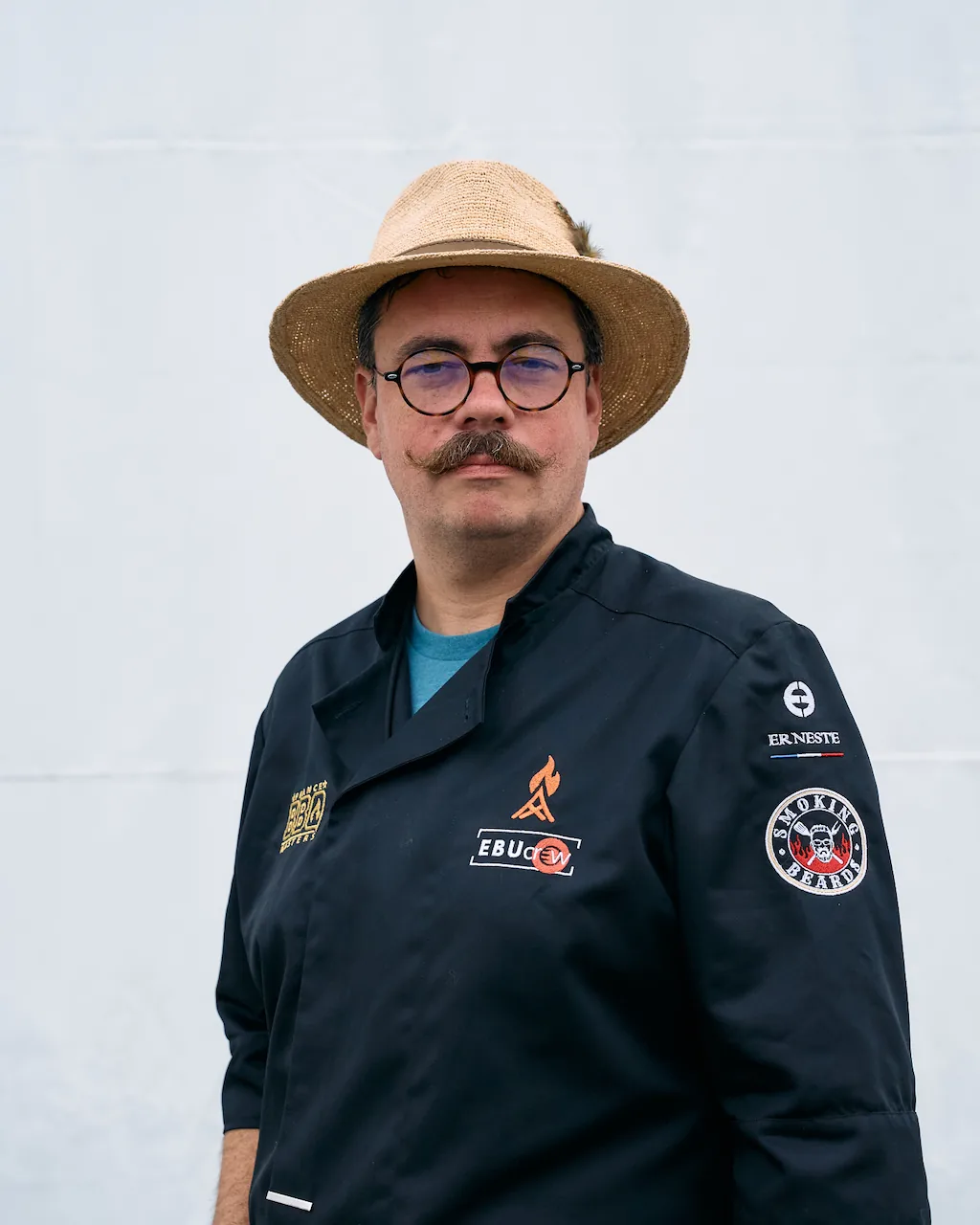
Fire was always there. Camping out with my father. Small cast-iron barbecues set straight on the ground. A sausage on a stick, the crust, the quiet around the embers. No need to overdo it: it was simple, it was real, and it stayed with me.
I come from a line of people rooted in the concrete — great-grandparents who farmed, a father who ran his own business. At fifteen, the family house became a restaurant to support my sister's project. Service, kitchen, rhythm: that's where I really started working.
But it was becoming a cabinetmaker that brought fire back as something obvious. In the workshop I cooked on the wood stove, tagines simmering while I worked. Fire stopped being a pastime: it became an instinct, a bearing, a tool.
At twenty I built my first barbecue. I experimented, I dug. Enough to go back to study and qualify as a chef in restaurant and catering — because I wanted more than to love fire: I wanted to master it, and to pass it on with some legitimacy. I became a teacher, then a workshop lead, without ever moving away from cooking with fire.
I then founded my first barbecue school, in Belgium, drawing on Flemish smoking, French gastronomy, Belgian technique — solid, precise, often overlooked — and more widely on fire cultures from all over the world.
I considered Quebec. It was Portugal that called: land of churrasco, of daily embers. I set up my working space in the mountains, in Góis. But I never stay in one place for long — every month I travel to Belgium, France, Spain, to train, to advise, to cook.
From kamado to offset, pellet to fire pit, plancha to smoker: I keep learning the techniques, and also how to make them visible and useful.